
Non-Life Insurers’ Average Solvency Margin Rises to 4.27 Times
Kathmandu — The solvency margin ratios of non-life insurance companies operating in Nepal have improved overall. By Mid-October, 2026 (end of Ashoj, 2083), the average solvency margin ratio of 14 non-life insurers had reached 4.27 times, up from 3.84 times in the corresponding period last year. This represents an increase of 0.43 times over the year.
Under the regulatory requirements of the Nepal Insurance Authority, non-life insurance companies must maintain a minimum solvency margin ratio of 130 percent, or 1.30 times. According to the latest figures, all 14 companies remain above this regulatory threshold. Even the company with the lowest ratio has a solvency margin of 2.73 times, more than double the minimum requirement.
Sanima GIC Insurance has the strongest solvency position, with a ratio of 5.85 times. The company has maintained the same ratio as last year, retaining its top position. Prabhu Insurance ranks second, with its ratio reaching 5.48 times, up from 4.66 times a year earlier, an improvement of 0.82 times.
Neco Insurance and IGI Prudential Insurance have solvency margin ratios of 5.06 times and 5.04 times, respectively, both unchanged from the previous year. Shikhar Insurance has maintained a ratio of 4.74 times, while United Ajod Insurance has retained its ratio of 4.29 times.
Nepal Insurance recorded a slight decline in its solvency margin ratio, which fell from 4.33 times last year to 4.28 times by the end of Ashoj this year. In contrast, NLG Insurance improved its ratio from 3.42 times to 4.24 times, an increase of 0.82 times.
National Insurance recorded the largest improvement in solvency margin among the companies. Its ratio increased from 1.67 times in the corresponding period last year to 4.00 times this year, a rise of 2.33 times. Similarly, Himalayan Everest Insurance improved its ratio from 3.32 times to 3.94 times, while Rastriya Beema Company increased its ratio from 2.73 times to 3.62 times.
Sagarmatha Lumbini Insurance (SALICO) also improved its solvency margin ratio, which rose from 2.75 times to 3.31 times. Siddhartha Premier Insurance maintained its previous year’s ratio of 3.18 times. The Oriental Insurance Company, which has the lowest ratio among the 14 insurers, improved its position from 2.66 times to 2.73 times.
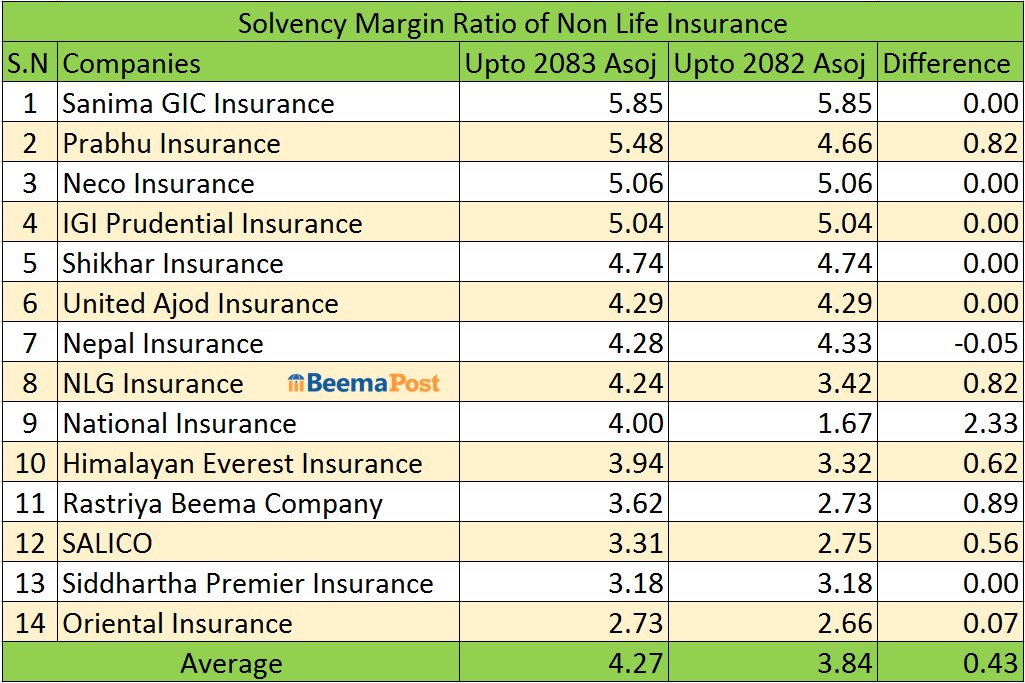
Overall, seven of the 14 companies recorded improvements in their solvency margin ratios, while six maintained their previous year’s levels. Only one company reported a slight decline. The increase in the sector’s average ratio from 3.84 times to 4.27 times indicates an improvement in the overall solvency position of Nepal’s non-life insurance industry.
The solvency margin ratio measures an insurance company’s ability to meet its financial obligations and withstand potential losses. Generally, a higher ratio indicates a stronger capacity to absorb risks and meet future claims. Despite the increased claims burden on non-life insurers following last year’s Gen Z protests and subsequent floods and landslides, all 14 companies have maintained ratios above the regulatory minimum, indicating that their solvency positions remain well above the required threshold.