
Solvency Ratios Decline Across Life Insurance Industry; IME Life Tops the Table
Kathmandu — The solvency margin ratio, a measure of financial strength and risk-bearing capacity, declined among life insurers in Nepal in the last fiscal year compared with the previous year. The industry’s average ratio fell by 0.47 times, from 2.31 times to 1.84 times.
According to the fourth-quarter financial statements published by insurers, IME Life Insurance recorded the highest solvency margin ratio at 2.59 times. The company improved its ratio by 0.37 times from 2.22 times a year earlier.
Reliable Nepal Life followed with a ratio of 2.54 times, placing second, although its ratio declined by 1.06 times from the previous fiscal year. Sun Nepal Life ranked third at 2.43 times, followed by MetLife at 2.08 times. These were the four companies with solvency ratios above 2 times.
Prabhu Mahalaxmi recorded a ratio of 1.91 times, Citizen Life 1.73 times, National Life 1.66 times, SuryaJyoti Life 1.65 times, LIC Nepal 1.61 times, Sanima Reliance Life 1.57 times, Nepal Life 1.54 times, Asian Life 1.33 times and Himalayan Life 1.84 times. Himalayan Life, which had the highest ratio of 3.86 times in the previous fiscal year, fell to the bottom of the rankings in the latest year.
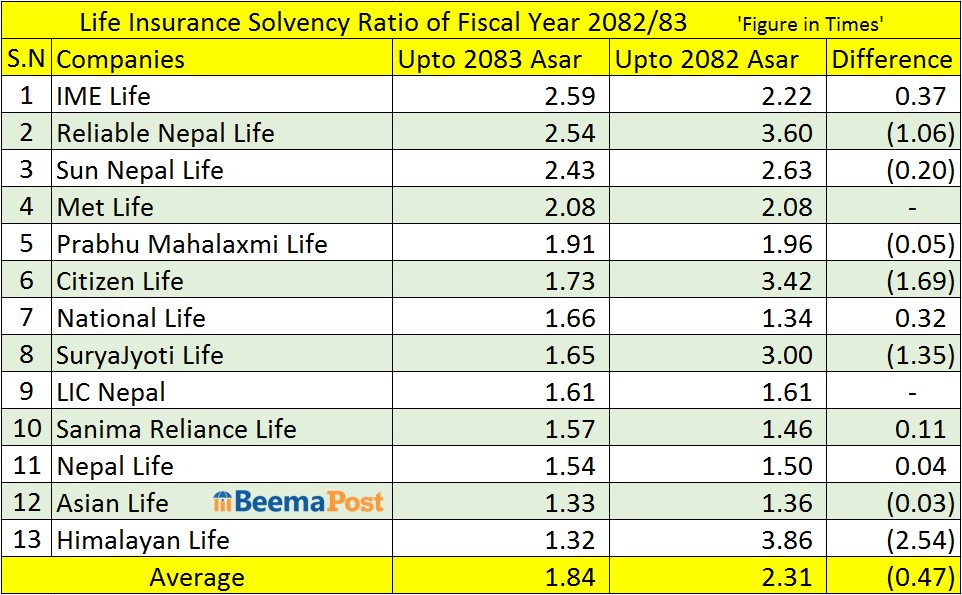
In terms of year-on-year changes, four companies recorded increases, two remained unchanged, and eight saw their solvency ratios decline. The ratios of Himalayan Life, Citizen Life, SuryaJyoti Life, Reliable Nepal Life, Sun Nepal Life, Prabhu Mahalaxmi and Asian Life fell by 2.54, 1.69, 1.35, 1.06, 0.20, 0.05 and 0.03 times, respectively.
The solvency margin ratio measures whether an insurance company holds sufficient capital and assets to meet its potential liabilities. The Nepal Insurance Authority requires life insurers to maintain a minimum solvency ratio of 1.30 times, or 130%. A higher ratio is generally considered to indicate greater capacity to absorb risk.
The state-owned Rastriya Jeevan Beema Company has not reported its ratio because its financial statements have not been audited.