
New Risk-Based Capital System Pulls Down Life Insurers’ Solvency Ratios, but Sector Remains Financially Sound
Kathmandu — The solvency ratio, a key indicator of the financial strength of life insurance companies, has declined significantly since the implementation of the risk-based capital system. An ICRA Nepal report has concluded that the decline reflects the new system’s more granular and risk-sensitive approach to measuring the risks borne by insurers, compared with the previous framework.
Solvency indicates a life insurer’s financial capacity to meet its future obligations to policyholders, absorb unexpected losses and expand into new business. As a result, regulators, policyholders, credit-rating agencies, investors, reinsurers, insurance intermediaries and other stakeholders have traditionally considered solvency an important basis for assessing an insurer’s financial condition.
The Risk-Based Capital and Solvency Directive, introduced in fiscal year 2022/23, brought a significant change to the system used to assess the capital adequacy of life insurance companies. Following its implementation, the Insurance Liability Valuation Directive, 2020, which had previously been in force, was replaced.
Under the previous framework, insurers were required to mathematically value their insurance liabilities and maintain adequate technical reserves. Such valuations used prudent assumptions while taking into account the protection of policyholders’ interests. The new risk-based capital framework, however, determines the amount of capital required according to the nature and magnitude of the risks assumed by an insurer, making the measurement of capital adequacy more risk-sensitive.
Under the risk-based capital framework, the solvency ratio is calculated by dividing an insurer’s available capital resources by its required risk-based capital. Available capital resources refer to the amount remaining after adjusting the excess of the company’s assets over its liabilities in accordance with the additions and deductions prescribed by the directive. Risk-based capital represents the regulatory capital required based on the specific risks assumed by the insurer. This also gives the Nepal Insurance Authority a basis for identifying potential financial problems within an insurer at an early stage.
The new framework sets the regulatory target for solvency at 130 percent, or 1.30 times. A higher ratio indicates that a company has a stronger capacity to absorb unexpected shocks and potential losses. As the ratio declines, however, regulators may need to increase supervisory oversight and take corrective measures before the company reaches a state of financial distress.
The Nepal Insurance Authority has established different solvency thresholds to provide early warnings and determine the level of regulatory intervention required. A ratio above 130 percent is considered the internal target level; companies within this range are subject to regular monitoring and periodic on-site inspections. A ratio between 100 percent and 130 percent is considered the regulatory target level — at this stage, companies may be required to submit corrective or business plans, face increased on-site inspections and more frequent reporting requirements, inject additional capital, and face restrictions on cash dividend distributions.
A ratio between 70 percent and 100 percent is classified as the regulatory intervention level. At this stage, restrictions on business operations or restructuring measures may be imposed, and companies may be required to inject additional capital. Restrictions may also be placed on cash dividend distributions, new business underwriting, lending and investments, and acquisitions of other companies. Regulators may also require changes to the board of directors or senior management, measures to reduce or mitigate risks, and a review of investment and reinsurance strategies.
A ratio between 45 percent and 70 percent is classified as the mandatory control level. In such cases, regulatory action may include removing or replacing members of the board or senior management, stopping new business and gradually winding down existing business, revoking the company’s license, and ultimately closing the company.
Company-level data also clearly shows the change in life insurers’ solvency ratios following the introduction of the new framework. The annual report of Rastriya Beema Company was unavailable for the period from fiscal year 2020/21 to 2024/25 and is therefore excluded. Looking at the remaining 13 life insurance companies, solvency ratios were comparatively high for most insurers before the risk-based capital system was introduced.
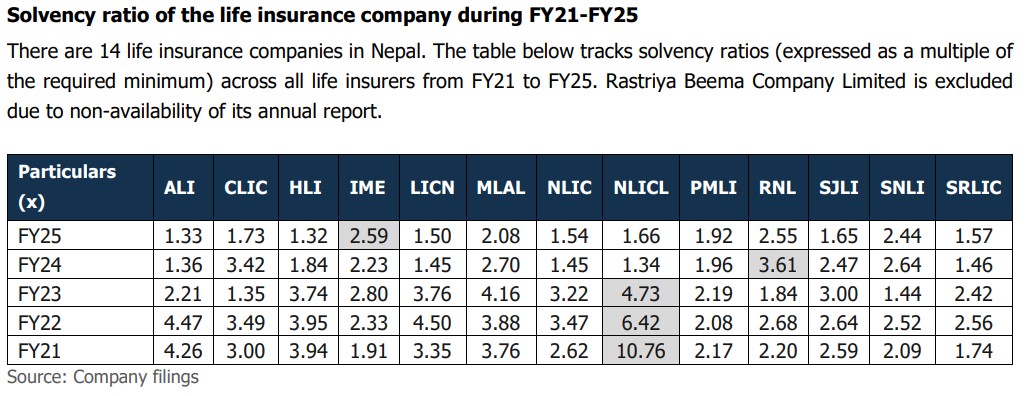
In fiscal year 2020/21, Asian Life had a solvency ratio of 4.26 times, Citizen Life 3.00 times, Himalayan Life 3.94 times, IME Life 1.91 times, Life Insurance Corporation Nepal 3.35 times, MetLife 3.76 times, Nepal Life 2.62 times, National Life 10.76 times, Prabhu Mahalaxmi Life 2.17 times, Reliable Nepal Life 2.20 times, SuryaJyoti Life 2.59 times, Sun Nepal Life 2.09 times, and Sanima Reliance Life 1.74 times.
After the risk-based capital framework came into effect in fiscal year 2023/24, most companies’ ratios declined sharply, though not uniformly. Asian Life’s solvency ratio stood at 1.36 times, Citizen Life’s at 3.42 times, Himalayan Life’s at 1.84 times, IME Life’s at 2.23 times, Life Insurance Corporation Nepal’s at 1.45 times, MetLife’s at 2.70 times, Nepal Life’s at 1.45 times, National Life’s at 1.34 times, Prabhu Mahalaxmi Life’s at 1.96 times, Reliable Nepal Life’s at 3.61 times, SuryaJyoti Life’s at 2.47 times, Sun Nepal Life’s at 2.64 times, and Sanima Reliance Life’s at 1.46 times.
In fiscal year 2024/25, there was no major divergence from the prior year’s ratios. Asian Life recorded a ratio of 1.33 times, Citizen Life 1.73 times, Himalayan Life 1.32 times, IME Life 2.59 times, Life Insurance Corporation Nepal 1.50 times, MetLife 2.08 times, Nepal Life 1.54 times, National Life 1.66 times, Prabhu Mahalaxmi Life 1.92 times, Reliable Nepal Life 2.55 times, SuryaJyoti Life 1.65 times, Sun Nepal Life 2.44 times, and Sanima Reliance Life 1.57 times.
The change in the industry’s average solvency ratio also illustrates the impact of the new framework. The average solvency ratio of the life insurance sector remained at around 3.24 times from fiscal year 2020/21 to 2022/23. After the risk-based capital framework was introduced, the average ratio declined to 1.99 times in fiscal years 2023/24 and 2024/25.
However, ICRA Nepal’s report does not interpret this decline as a deterioration in the underlying financial strength of life insurance companies. It concludes that solvency ratios naturally appear lower under the new system because it assigns comparatively higher capital charges to various risk factors than the previous framework did. In other words, the primary driver of the decline is the change in risk-measurement methodology, not a deterioration in companies’ asset and liability positions.
The contraction in solvency ratios between fiscal years 2020/21 and 2024/25 has not been limited to one or a few financially weaker companies but has been observed across most insurers. This indicates that the new system measures risk more sensitively across the board. In this sense, the report notes, Nepal’s solvency framework has also moved closer to international regulatory practice.