
Life Insurers’ Average Solvency Ratio Declines; IME Life Leads
Kathmandu — The solvency margin ratios of life insurance companies in Nepal, an indicator of their capacity to withstand financial risks, have declined, according to their first-quarter financial statements for fiscal year 2026/27.
The average solvency margin ratio of life insurers fell to 1.84 times as of October 17, 2026, from 2.26 times in the corresponding period of the previous fiscal year. The table published by the companies reports a decline of 0.41 times.
IME Life Insurance recorded the highest solvency ratio at 2.59 times as of October 17, 2026. Its ratio improved from 2.22 times in the corresponding period last year, an increase of 0.37 times. Reliable Nepal Life ranked second at 2.54 times, although its ratio declined by 1.07 times from 3.61 times a year earlier.
Sun Nepal Life reported a solvency ratio of 2.43 times, while MetLife’s stood at 2.08 times. Both companies maintained the same ratios as in the corresponding period last year.
Prabhu Mahalaxmi Life’s ratio declined from 1.96 times to 1.91 times, a decrease of 0.05 times. Citizen Life’s ratio fell from 3.42 times to 1.73 times, a decline of 1.69 times.
National Life recorded an improvement, with its solvency ratio rising from 1.34 times to 1.66 times, an increase of 0.32 times. In contrast, SuryaJyoti Life’s ratio declined from 2.47 times to 1.65 times, a decrease of 0.82 times. LIC Nepal maintained its ratio at 1.61 times, unchanged from the previous year.
Sanima Reliance Life’s solvency ratio improved from 1.46 times to 1.57 times, an increase of 0.11 times, while Nepal Life’s rose from 1.50 times to 1.54 times, an increase of 0.04 times.
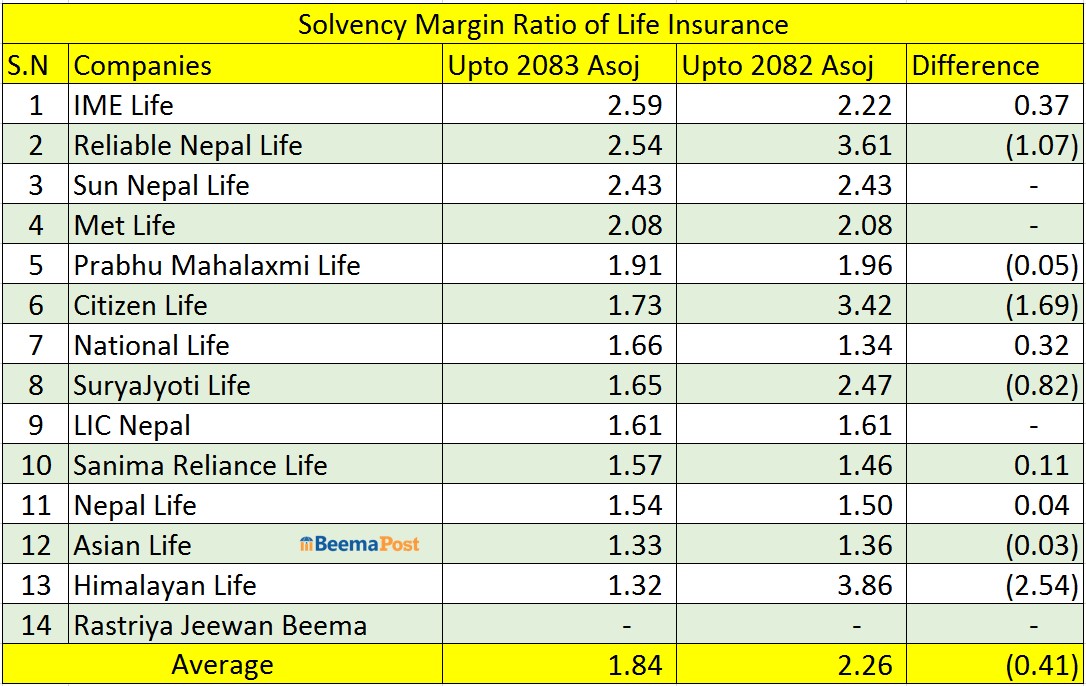
Asian Life’s ratio declined from 1.36 times to 1.33 times, a decrease of 0.03 times. The steepest decline was recorded by Himalayan Life, whose solvency ratio plunged from 3.86 times to 1.32 times, a drop of 2.54 times. Rastriya Jeevan Beema Company has not disclosed its solvency margin ratio.
The Nepal Insurance Authority requires life insurance companies to maintain a minimum solvency margin ratio of 1.30 times. Based on the published figures, all 13 companies that disclosed their ratios remained above the regulatory minimum.
The solvency margin ratio measures an insurer’s capital strength in relation to the capital required to meet future insurance liabilities and other financial risks. It indicates a company’s ability to withstand potential financial shocks and fulfil its claim obligations. Generally, a higher solvency ratio indicates a stronger capacity to absorb financial risks.