
Pakistan’s Bid for Canadian Support on Indus Treaty Restoration Draws no Public Backing
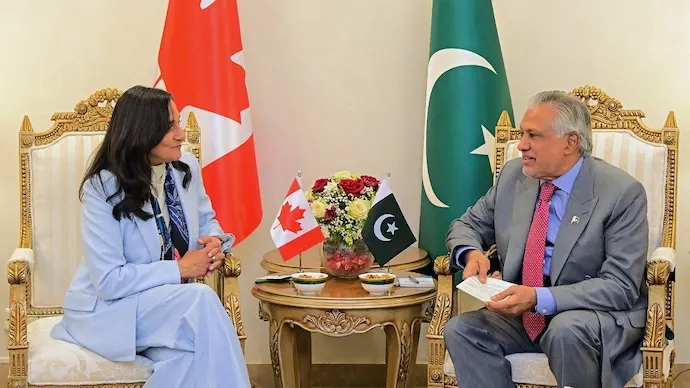
Islamabad — Pakistan failed to secure public support from Canada for its call to restore the Indus Waters Treaty (IWT) with India, as Canadian Foreign Minister Anita Anand made no mention of the issue during or after her visit to Islamabad on Monday.
Standing alongside Anand at a joint press conference, Pakistan’s Deputy Prime Minister and Foreign Minister Ishaq Dar appealed to Canada and other partners to support Islamabad’s demand for the immediate reinstatement of the 1960 water-sharing pact.
“We seek the support of our friendly countries, including Canada, towards India’s immediate restoration of the IWT, ending the weaponisation of water and upholding international law and treaty obligations,” Dar said.
Canada, however, offered no public endorsement. An official Canadian statement issued after the meeting highlighted bilateral ties and cooperation in areas of mutual interest but omitted any reference to the Indus Waters Treaty or Pakistan’s appeal.
India suspended the treaty following the April 2025 terrorist attack in Pahalgam, Jammu and Kashmir, which killed 26 people. New Delhi has said the agreement will remain in abeyance until Pakistan takes credible action against cross-border terrorism.
Dar said India’s decision had introduced a fresh source of instability into an already fragile regional security environment and urged the international community to oppose what he described as the “weaponization of water.”
Brokered by the World Bank and signed in 1960, the Indus Waters Treaty governs the sharing of the Indus river system between the two nuclear-armed neighbors. It allocates the three eastern rivers to India while granting Pakistan primary rights over the three western rivers, subject to limited upstream use by India.
The treaty established the Permanent Indus Commission to manage technical cooperation and provides a dispute-resolution mechanism involving neutral experts, arbitration and the World Bank. Pakistan maintains that the agreement does not allow either party to suspend or revoke it unilaterally.
Since India put the treaty in abeyance, Islamabad has repeatedly criticized the move as a violation of international law while stepping up diplomatic efforts to rally international support for its restoration.