
World Bank-IMF Annual Meetings Open in Bangkok, Focusing on Jobs and Global Economic Stability
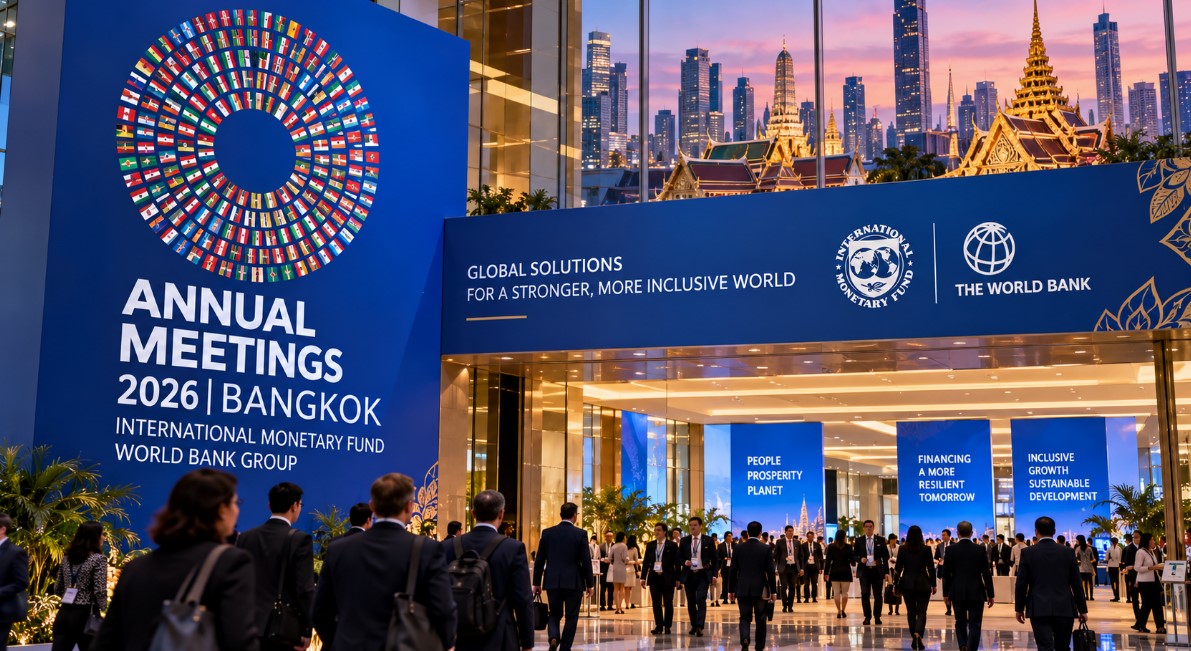
Kathmandu/Bangkok — The joint Annual Meetings of the International Monetary Fund (IMF) and the World Bank Group opened in Bangkok, Thailand, on October 12. Global policymakers are gathering to discuss the world economy, financial stability and development strategies.
The meetings run through October 18 and are expected to draw more than 15,000 participants from 191 countries, including Nepal. The venue is the Queen Sirikit National Convention Center (QSNCC). Finance ministers, central bank governors, economic policymakers, private-sector representatives, civil society groups and development partners are expected to attend. Key agenda items include global growth, job creation, climate change, public debt and the growing influence of technology on the economy.
Thailand is hosting the Annual Meetings for the second time since 1991 under the theme “Thailand’s New Horizons: Empowering People, Building Resilience.” The theme stresses strengthening people’s capabilities, reinforcing economic and financial systems, and expanding international cooperation.
One featured discussion, “Small AI, Big Jobs,” held on October 12, examines how smaller-scale artificial intelligence applications could help small and medium-sized enterprises (SMEs) raise productivity and competitiveness and create jobs. On October 14, the World Bank Group will host a special event, “Mobilizing Private Capital for Jobs,” on attracting private investment into developing economies, where public budgets and foreign aid alone may not meet investment needs. Infrastructure, industry, energy, agriculture, tourism and digital services are among the sectors needing additional financing. Discussions are expected to cover policies to attract investment, public-private partnerships, risk mitigation and ways to increase investment’s employment impact.
Climate change, natural disasters and environmental risks are also expected to feature prominently, as they add financial pressure on developing economies. Another major issue is rising public debt and borrowing costs, including how high interest rates, market volatility, energy price swings and geopolitical tensions affect investment decisions by governments and businesses.
For Nepal, which faces significant geographical and climate-related risks, priorities could include climate finance, disaster risk reduction, protection of hydropower and infrastructure assets, and financing for sustainable development. The meetings also offer a chance to engage development partners on debt management, infrastructure, private-sector development, the digital economy and employment, with possible focus areas in hydropower, tourism, agricultural modernization and roads. However, the government has not formally disclosed its participation or agenda, and the effectiveness of Nepal’s engagement may depend on its ability to present clear proposals.
The Civil Society Policy Forum, regional economic report discussions and seminars run from October 12 to 18. The Development Committee meets on October 15, followed by the formal plenary session on October 16 and the International Monetary and Financial Committee (IMFC) plenary on October 17.
Photo: Diane Feria/The Morning Telegraph