
Nepal Life Accused of Defying Court Ruling and Issuing Misleading Statement Over Rs 1.5 Million Claim
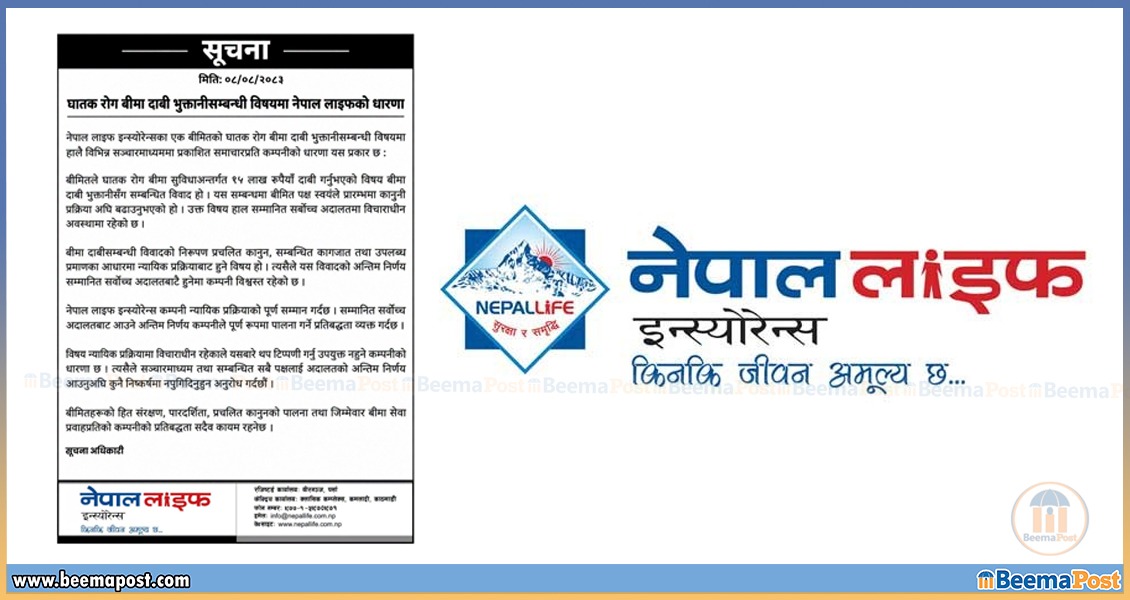
Kathmandu — Nepal Life Insurance Company has been found of using legal procedures to delay payment of an insurance claim. A recent statement from the company has raised further questions about its handling of the case.
Under Nepal’s prevailing laws, a decision becomes final once consistent rulings are delivered at two levels on the same matter. It must then be implemented immediately and unconditionally. Company executives and directors could potentially face contempt proceedings if they fail to comply.
The case concerns policyholder Indra Bahadur Rijal, who is entitled to a Rs 1.5 million critical illness benefit. Instead of implementing the ruling and making the payment, Nepal Life allegedly issued a misleading statement and encouraged policyholders and insurance agents to circulate it, Beema Post has found.
The Insurance Authority, acting as the original adjudicating body, ruled in favor of the policyholder. The Patan High Court later upheld the decision, so the ruling should proceed to implementation. The company, however, has reportedly delayed enforcement by the regulator. It claims that another case is pending before the Supreme Court.
An investigation by Beema Post found that Nepal Life’s claim that the Supreme Court had admitted the matter for hearing was misleading. A petition involving Indra Bahadur Rijal and Nepal Life Insurance has indeed been registered at the Supreme Court. But a regular appeal is not available in this type of case. The company therefore filed a petition seeking a review of the decision.
In such proceedings, a petition receives leave for review only after it is listed before a bench and the court issues an order on whether to proceed with the hearing. According to the report, Nepal Life’s petition has not yet been heard. The company has therefore been accused of misleading the public. It described the matter as pending before the Supreme Court without clarifying that no hearing has taken place.
The Patan High Court issued its final ruling on March 24, 2026. It states that the case should be sent back to the original adjudicating body, the Insurance Authority, for implementation. It also states that the case record should be closed at the High Court.
Namrata Gaire, information officer at the Patan High Court, said that once the High Court upholds a decision of the Insurance Authority, it should proceed to implementation. “After the case is sent from here to the original adjudicating body, the Insurance Authority, the decision must be implemented there,” she said.
Nepal Life Information Officer Binod Bhujel, meanwhile, maintained that the company had received leave from the Supreme Court. He told Beema Post that the company holds a court-stamped document, which it considers proof of leave.
Asked to provide evidence of the date the case was listed for hearing and the judge who granted leave, Bhujel declined to comment. He said the matter was currently before the court. “We have paid billions of rupees to policyholders. There is no reason for us to withhold Rs 1.5 million. This may be the first time a case concerning critical illness has reached the Supreme Court in this manner, and we want to establish a new precedent,” he said.
Policyholder Rijal, however, accused Nepal Life of submitting misleading information to both the Insurance Authority and the Office of the Prime Minister and Council of Ministers. He said the company had not received leave from the Supreme Court. The case was scheduled to be listed in Magh (mid-January to mid-February), he said, when the court would hear arguments on whether to grant leave for review.
In similar cases in the past, courts have directed the Insurance Authority to implement decisions within seven days and submit a compliance report. In a case involving Sagarmatha Insurance and Ram Karki of Gaur Shankar Furniture, the High Court ordered immediate implementation of the decision.
Insurance companies with billions of rupees in investments have long been accused of using legal procedures to intimidate and burden policyholders and delay claim payments. Nepal Life’s handling of the latest case has once again raised concerns about this practice.