
Middle East Conflict Weighs on Asia-Pacific Outlook as Nepal Growth Slows, ADB Says

The Asian Development Bank has warned that the escalating Middle East conflict is increasingly undermining economic prospects across Asia and the Pacific, with rising energy prices, supply disruptions, and financial volatility expected to slow growth and push inflation higher across the region.
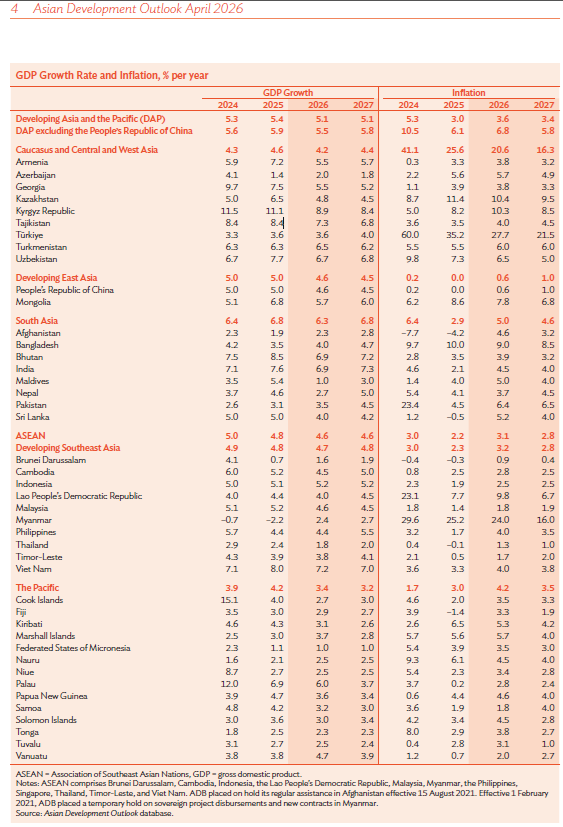
In its Asian Development Outlook April 2026, the ADB projects regional growth to moderate to 5.1% in both 2026 and 2027, down from 5.4% in 2025, as external pressures intensify. Inflation is forecast at 3.6% in 2026 and 3.4% in 2027, though risks remain firmly tilted upward if the conflict persists.
The economic strain is closely linked to the sharp escalation of conflict in late February 2026, which disrupted energy production and major shipping routes. Oil prices surged by about 70%, raising costs across production, transport, and household consumption. For Asia’s energy-importing economies, this has translated into rising inflation, weaker demand, and tighter financial conditions.
Beyond energy, the report highlights widening spillover effects through higher fertilizer prices, which are pushing up agricultural costs and food inflation, as well as potential disruptions in semiconductor supply chains due to shortages of key industrial inputs. Tourism and remittance flows are also at risk due to reduced connectivity and economic uncertainty in the Middle East.
Financial markets have already reacted, with falling equity prices, rising bond yields, depreciating currencies, and widening risk premiums across the region. While capital outflows remain contained, the ADB cautions that further escalation could significantly tighten financial conditions and increase debt vulnerabilities.
The regional outlook is further reinforced by country-level projections, including new data on Nepal, where the economy is expected to slow sharply. Nepal’s growth is forecast at 2.7% in fiscal year 2026, down from 4.6% in FY2025, reflecting political uncertainties, the lingering effects of past domestic unrest, and external pressures from the Middle East conflict. Growth is then expected to recover to 5.0% in FY2027 as domestic demand, tourism, and hydropower exports strengthen.
Inflation in Nepal is projected at 3.7% in FY2026, rising further to 4.5% in FY2027, driven by stronger domestic activity and higher import costs. The conflict is also expected to strain Nepal’s external sector, with the current account surplus narrowing to 7.2% of GDP in FY2026 from 6.7% in FY2025, reflecting higher import bills and weaker remittance growth. It is projected to moderate to 5.3% in FY2027.
ADB officials note that Nepal remains particularly exposed to external shocks through remittances, tourism, and oil prices, all of which are sensitive to developments in the Middle East. A prolonged conflict could further weaken remittance inflows from Gulf economies and increase volatility in global oil markets, amplifying risks to the country’s economic stability.
Across the wider region, the ADB outlines a more adverse scenario in which prolonged disruptions could push regional growth down to 4.7% in 2026 and 4.8% in 2027, while inflation could rise to 5.6%. In a severe escalation scenario and steep escalation of oil price, growth can reduce by 1.3 percentage points over two years and significantly intensifying inflationary pressures.
Subregional trends show a broad-based slowdown. South Asia remains relatively resilient with 6.3% growth in 2026, supported by strong domestic demand, while East Asia is expected to slow to 4.6%, Southeast Asia to 4.7%, and the Pacific to 3.4%. However, rising costs, weaker global demand, and geopolitical uncertainty are expected to weigh on all subregions.
The ADB concludes that while Asia and the Pacific entered 2026 with solid economic momentum, the evolving Middle East conflict presents a significant and complex challenge. Its impact through energy markets, trade, and financial channels is likely to test the region’s resilience, with countries like Nepal facing heightened vulnerability due to their reliance on external flows and imported energy.