
From the Archives: FNJ Annual Assembly Labels Supreme Court’s News Takedown Order a Threat to Press Freedom
May 25th, 2026

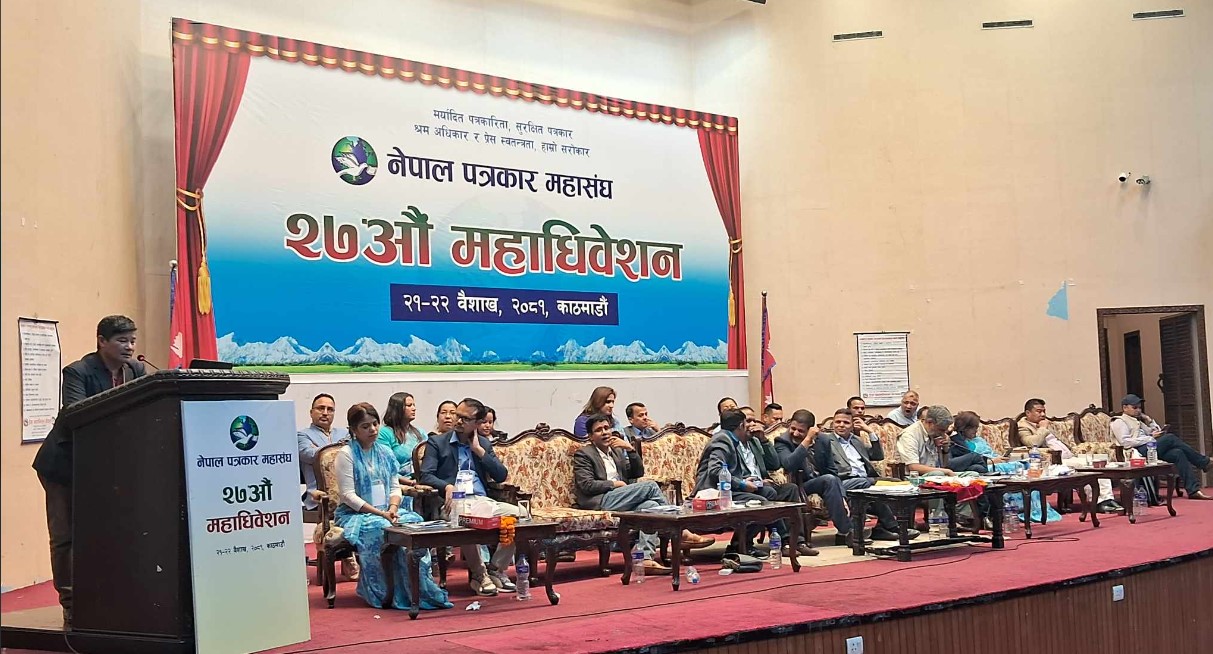
Kathmandu – The central annual assembly of the Federation of Nepali Journalists (FNJ) has concluded that the recent order issued by Nepal’s Supreme Court directing the removal of published news content undermines the constitutional guarantee of full press freedom and has held the country’s highest judicial body responsible for acting against that principle.

Through the adoption of the Kathmandu Declaration, the 27th General Convention of the Federation of Nepali Journalists passed a resolution formally criticizing the Supreme Court and, for the first time, characterized it as an institution acting against press freedom. The declaration, endorsed by central representatives, former presidents, and delegates from across the country, states in its first provision that Nepal’s Supreme Court has acted contrary to the principle of a free press and calls upon all three branches of the state; the executive, legislature, and judiciary; to uphold the constitutional commitment to complete press freedom.

The assembly, held in Kathmandu yesterday, expressed serious concern over the Supreme Court’s recent order requiring the removal of news content and concluded that the move had dealt a significant blow to the constitutional protection of press freedom in Nepal.

Clause 1 of the Kathmandu Declaration states: “This General Convention expresses serious concern over the recent order issued by the Honorable Supreme Court regarding published news content. The decision to compel the removal of published materials, prohibit republication or rebroadcasting, and pursue criminal proceedings over news content is deemed unconstitutional. Therefore, this convention strongly urges all three organs of the state; the executive, legislature, and judiciary; to ensure the full protection of constitutionally guaranteed press freedom.”

The convention also passed a motion of concern directed at the Press Council Nepal. Following extensive debate among delegates over the council’s reported instructions to remove news content in ways viewed as inconsistent with constitutional protections, Clause 7 of the Kathmandu Declaration formally expressed dissatisfaction with the council’s actions and urged it to act in accordance with the Constitution and existing laws.

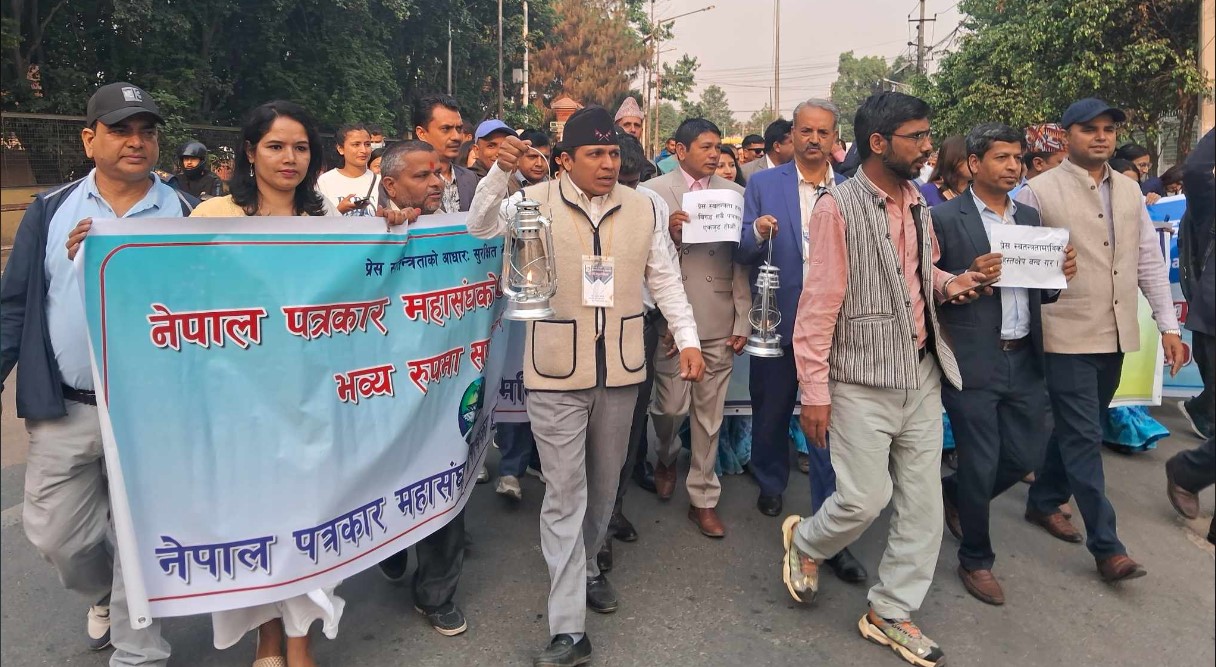
According to the report, independent journalists had earlier organized a lantern protest that pushed the FNJ to openly debate the issue of press freedom and the Supreme Court’s order. Delegates reportedly engaged in extensive discussions during the convention.

The controversy referenced by the convention relates to an audio recording published on May 27, 2024 by the online outlet Sidhakura Dot Com, which claimed that the Constitutional Bench of the Supreme Court had influenced a decision to overturn anti-corruption sting operations conducted by the anti-graft agency through an alleged bribery arrangement worth NPR 1.60 billion. The report also mentioned the names of media executives, a Supreme Court judge, lawyers, and journalists. According to the article, without establishing the factual basis of the claims, a bench led by Justices Nahakul Subedi and Tek Prasad Dhungana ordered the news content removed within 24 hours and directed criminal proceedings against the reporting journalist. Based on that order, the Supreme Court has reportedly already recorded lengthy statements from journalist Nabin Dhungana and the publisher.
The 27th General Convention concluded yesterday after issuing an 18-point Kathmandu Declaration. Among other resolutions, the convention called on journalists to embrace the principle of “Journalism for the Planet” and contribute through reporting to efforts aimed at reducing the impacts of climate change.

The article further argues that by adopting a formal resolution stating that the Supreme Court’s order amounted to an infringement of press freedom, the convention has increased international attention on the issue. Since FNJ is affiliated with organizations including the International Federation of Journalists (IFJ) and other international bodies, the declaration could influence how international institutions engage with developments in Nepal’s media environment. The report suggests that unless the disputed judicial actions are addressed, international attention or missions could follow.

It also argues that such developments could place additional pressure on the Supreme Court and affect its public image internationally.

The 27th General Convention of the Federation of Nepali Journalists was inaugurated by Prime Minister Pushpa Kamal Dahal.

Kathmandu Declaration Issued by the 27th General Convention of the Federation of Nepali Journalists

Date: May 5, 2024

The 27th General Convention of the Federation of Nepali Journalists (FNJ) issues the following declaration in support of the full implementation of the Constitution, the protection of complete press freedom, enforcement of the Working Journalists Act, and the institutional development and advancement of journalism:

1. This convention expresses serious concern over the recent order issued by the Supreme Court regarding published news content. The convention concludes that compelling the removal of published material, restricting republication or rebroadcast, and treating news reporting as a criminal offense are inconsistent with the Constitution. It therefore strongly calls on all three organs of the state—the executive, legislature, and judiciary—to ensure the full protection of constitutionally guaranteed press freedom.

2. The convention announces that elections of the Federation of Nepali Journalists will be held on June 8, 2024, and directs the federation to complete all necessary preparations. It also instructs the FNJ Central Committee to settle and publicly disclose all membership verification matters within April in accordance with the federation’s constitution and the 2022 membership verification standards.

3. The convention directs the federation to ensure that decisions concerning activities, programs, awards, and recognitions are guided by clear procedures and criteria that uphold inclusion, proportional representation, respect for social class, region, gender, language communities, religion, and culture, while preserving the federation’s collective character in practice.

4. The convention strongly urges governments at all three levels to make media-related bills currently under consideration fully media-friendly and consistent with the guarantees of press freedom and freedom of expression. It further calls for refraining from policies or actions that could undermine these freedoms.

5. Taking into account the ongoing dispute regarding the founding president of the Federation of Nepali Journalists, the convention instructs the federation to carry out study and research in coordination with the Department of Mass Communication and Journalism and the Department of History at Tribhuvan University, and reach conclusions based on facts and evidence.

6. The convention strongly calls on the government to double the amount allocated for public welfare advertising and to increase and fully implement the minimum wage provisions for working journalists.

7. The convention expresses concern over recent actions by Press Council Nepal in directing media outlets to remove news content beyond its jurisdiction and urges the council to act in accordance with the Constitution and existing laws.

8. Expressing concern that working journalists have gone without salaries and benefits for extended periods, the convention calls on concerned media organizations to provide overdue payments immediately. It also calls for full implementation of the Working Journalists Act and urges closer coordination and institutional mechanisms among media owners, journalists, and the government to seek long-term solutions.

9. Emphasizing the sustainable and reliable development of self-employed media outlets and media operating in various mother tongues with limited investment, the convention calls for the immediate implementation of a proportional advertising system.

10. The convention urges the government to allow print publications that transition into digital platforms to retain continuity and recognition. It also calls for doubling existing support and benefits provided to media organizations operated by conflict survivors, Dalits, persons with disabilities, third-gender communities, and women journalists.

11. Calling for initiatives to protect and promote local and small-investment media institutions, the convention urges the government to implement proportional advertising policies and establish mandatory provisions requiring local advertising to be allocated to local media.

12. The convention calls on the government to convert the existing free accident insurance scheme for working journalists into health insurance and ensure its effective implementation.

13. Recognizing the country’s diversity and pluralism, the convention calls on all media institutions to make their editorial content and organizational structures gender-sensitive, inclusive, disability-friendly, and to create safer workplaces.

14. The convention urges the immediate abolition of impractical and burdensome administrative procedures imposed by government agencies—including Press Council Nepal, the Department of Information and Broadcasting, and the Advertising Board—in matters related to media registration, renewal, regulation, and access to services.

15. The convention calls on all journalists to uphold the code of ethics, practice responsible and dignified journalism, and contribute to social awareness through constructive reporting.

16. The convention urges the government to introduce policies and programs focused on strengthening journalists’ capacities to respond to emerging trends and challenges in journalism and to establish scholarship opportunities for journalists pursuing higher education in journalism.

17. Embracing the guiding principle of “Journalism for the Planet,” the convention calls on all media professionals to contribute through their work toward reducing the impacts of climate change.

18. The convention extends its gratitude to all participants of the opening ceremony of the 27th General Convention of the Federation of Nepali Journalists, including Prime Minister Pushpa Kamal Dahal, Communications and Information Technology Minister Rekha Sharma, representatives of political parties, former presidents of the federation, leaders and representatives of journalist organizations, and all Central Council members from across the country.

Roshan Puri
General Secretary

Your Comment

Your email address will not be published. Required fields are marked *


*