
US Defense Capabilities Questioned After Iran Downs Apache Helicopter
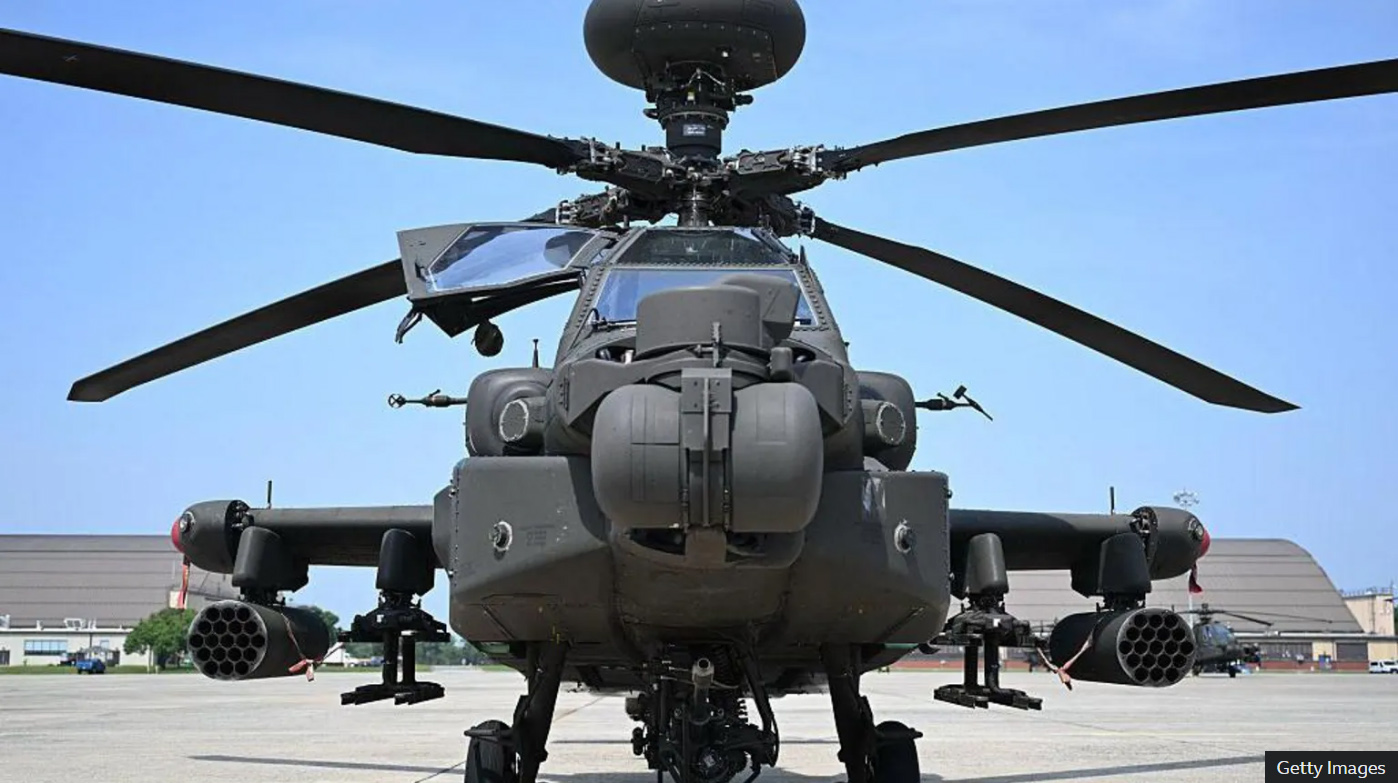
KATHMANDU, June 10 — A high-stakes military escalation has unfolded in the Middle East after Iran shot down a state-of-the-art U.S. AH-64 Apache attack helicopter over the Strait of Hormuz tuesday. The incident, which occurred at approximately 3:30 AM local time on Tuesday during a routine patrol, has raised questions about the defensive capabilities of one of the world’s most heavily armored aircraft. It has been analyzed that the United States should not underestimate Iran’s precise targeting, strikes, and tracking capabilities following the incident.
According to the U.S. Military’s Central Command (CENTCOM), both crew members were successfully rescued following the crash.
Despite a nominal ceasefire being in place between the two nations, Iranian forces reportedly intercepted the helicopter using a new, advanced drone technology, perceiving the U.S. aircraft as an active threat. In immediate retaliation, the United States launched targeted military strikes against Iran’s Bandar Abbas port and several strategic islands near the Strait. Iran countered by claiming responsibility for a retaliatory strike aimed at the U.S. Fifth Fleet base in Bahrain.
Manufactured by aerospace giant Boeing, the AH-64 Apache is powered by twin General Electric turboshaft engines and is valued at roughly $50 million (approx. 6.7 billion Nepalese Rupees). Capable of reaching speeds of 279 km/h, the formidable gunship features advanced radar tracking, a 30mm M230 automatic chain gun, 70mm Hydra rockets, and up to 16 anti-tank missiles.
The single-strike downing of the Apache has sent shockwaves through global defense markets, causing a slight dip in Boeing’s stock price. Boeing has delivered over 700 Apaches to the U.S. military alone, and the platform is a cornerstone of several international defense frameworks. The U.S. has widespread agreements to export the helicopter; Poland recently signed a $4.7 billion deal for deliveries by 2028, while South Korea, Israel, Saudi Arabia, Indonesia, and India maintain significant Apache fleets.
As military analysts review how Iran bypassed the helicopter’s sophisticated electronic warfare suites, the incident casts a shadow over the perceived invulnerability of modern Western defense technology.
Picture Courtesy: Getty Image