
Why Xi Jinping’s Rare Trip to North Korea Matters Right Now
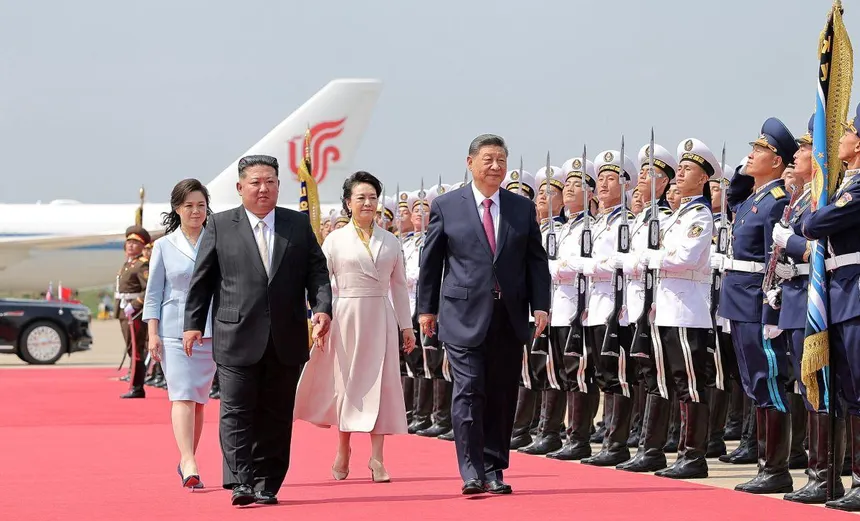
Pyongyang — Chinese President Xi Jinping’s arrival in Pyongyang this week is drawing attention across Northeast Asia, not because Beijing and North Korea lack contact, but because Xi rarely chooses to travel abroad for high-level diplomacy anymore.
The visit comes at a moment when the strategic landscape surrounding the Korean Peninsula is changing rapidly. While China and North Korea have maintained close political ties for decades, Beijing is increasingly confronted by a new reality: Pyongyang is no longer dependent on China in the way it once was.
For years, China stood as North Korea’s dominant economic lifeline, accounting for the overwhelming majority of the country’s foreign trade and serving as its most important diplomatic partner. That arrangement, however, has been complicated by North Korea’s growing partnership with Russia.
Since the outbreak of the war in Ukraine, relations between Moscow and Pyongyang have deepened dramatically. North Korea has supplied Russia with military equipment and manpower, while Russia has reportedly expanded economic and technological cooperation with the Kim Jong Un government. The result is a relationship that gives North Korea greater room to maneuver and reduces its reliance on Beijing.
Against that backdrop, Xi’s decision to travel to Pyongyang appears aimed at reinforcing China’s position as North Korea’s most influential partner. Rather than allowing Moscow to become Pyongyang’s primary strategic benefactor, Beijing is seeking to remind North Korea of the political and economic advantages that come with maintaining strong ties to China.
The timing is particularly notable because Xi has significantly reduced his overseas travel compared with the early years of his presidency. In recent years, foreign leaders have more often traveled to Beijing to meet him than the other way around. A visit to North Korea therefore signals that Chinese leaders view current developments on the Korean Peninsula as important enough to warrant direct engagement.
China’s concerns extend beyond influence alone. Beijing has long preferred stability on the peninsula and has traditionally been cautious about North Korea’s military development. While China remains a treaty ally of North Korea, it does not necessarily welcome a situation in which Pyongyang acquires increasingly sophisticated military technologies through cooperation with Russia.
A more militarily capable North Korea could introduce new uncertainties into a region already marked by competing security interests. Chinese policymakers are particularly attentive to anything that could alter the balance of power or trigger stronger military responses from neighboring countries.
Recent events have reinforced those concerns. North Korea continues to advance its missile and nuclear programs, while regional security cooperation among countries aligned with the United States is also gaining momentum. South Korea and Japan have moved closer on defense coordination, and discussions about expanded security cooperation continue to shape regional diplomacy.
From Beijing’s perspective, these developments risk creating a more polarized security environment in East Asia. China therefore has incentives to maintain influence over Pyongyang while also discouraging actions that could intensify regional tensions.
At the same time, Xi’s visit may serve a broader diplomatic purpose. China presents itself as a key stakeholder in any future discussions involving the Korean Peninsula, whether related to denuclearization, regional security, or possible engagement between North Korea and the United States. Maintaining close communication with Kim Jong Un helps ensure that Beijing remains central to those conversations.
For North Korea, the visit offers an opportunity to demonstrate that it retains strong backing from two major powers simultaneously. Pyongyang’s growing relationship with Russia has expanded its options, but preserving strong ties with China remains crucial for economic stability and diplomatic support.
As geopolitical competition intensifies across East Asia, Xi’s trip highlights a larger strategic calculation. China is not simply strengthening a longstanding alliance; it is responding to a changing regional order in which influence, security, and economic leverage are increasingly contested.
The significance of the visit lies less in the meeting itself than in what it reveals about Beijing’s priorities. By traveling to Pyongyang, Xi is signaling that North Korea remains a critical piece of China’s regional strategy and that Beijing intends to remain deeply involved in shaping the future balance of power on the Korean Peninsula.
Photo Courtesy: Reuters