
Non-Life Insurers’ Catastrophe Funds Exceed NPR 2.20 Billion as Companies Strengthen Disaster Reserves

Kathmandu — Nepal’s non-life insurance companies have continued to strengthen their financial buffers against large-scale disasters, with the combined balance of catastrophe funds maintained by 14 insurers rising to more than NPR 2.20 billion by the May of FY 2025/2026 (Chaitra of 2082/83).
According to the unaudited financial statements for the first nine months of the fiscal year, the total catastrophe fund held by the country’s non-life insurers reached NPR 2.2059 billion, up from NPR 2.1280 billion during the same period a year earlier. The increase of 3.66 percent reflects the sector’s ongoing efforts to build reserves capable of absorbing the financial impact of major natural and man-made disasters.
Catastrophe funds are maintained by insurance companies to cover potential claims arising from high-impact events such as earthquakes, floods, landslides, fires, and other unforeseen disasters. While insurers generally settle claims from the premiums they collect, large-scale catastrophes can generate an unusually high volume of claims that place significant pressure on their financial resources. These dedicated reserves therefore play a critical role in preserving financial stability and ensuring that policyholders receive timely claim payments during periods of crisis.
Among Nepal’s non-life insurers, Rastriya Beema Company maintains the largest catastrophe fund. As of the end of Chaitra, the state-owned insurer had accumulated NPR 706.72 million in its reserve fund, compared with NPR 692.27 million a year earlier.
Siddhartha Premier Insurance ranked second with NPR 231.87 million, followed closely by Sagarmatha Lumbini Insurance (SALICO) with NPR 226.76 million. Neco Insurance reported catastrophe reserves of NPR 170.27 million, while Shikhar Insurance held NPR 164.68 million.
Other insurers also maintained sizeable reserves. Nepal Insurance reported NPR 117.46 million in its catastrophe fund, while Prabhu Insurance held NPR 111.85 million. IGI Prudential Insurance had accumulated NPR 96.15 million, followed by NLG Insurance with NPR 88.34 million and Himalayan Everest Insurance with NPR 87.72 million. Oriental Insurance reported reserves of NPR 76.73 million, while Sanima GIC Insurance, United Ajod Insurance, and National Insurance held NPR 48.51 million, NPR 47.02 million, and NPR 31.87 million respectively.
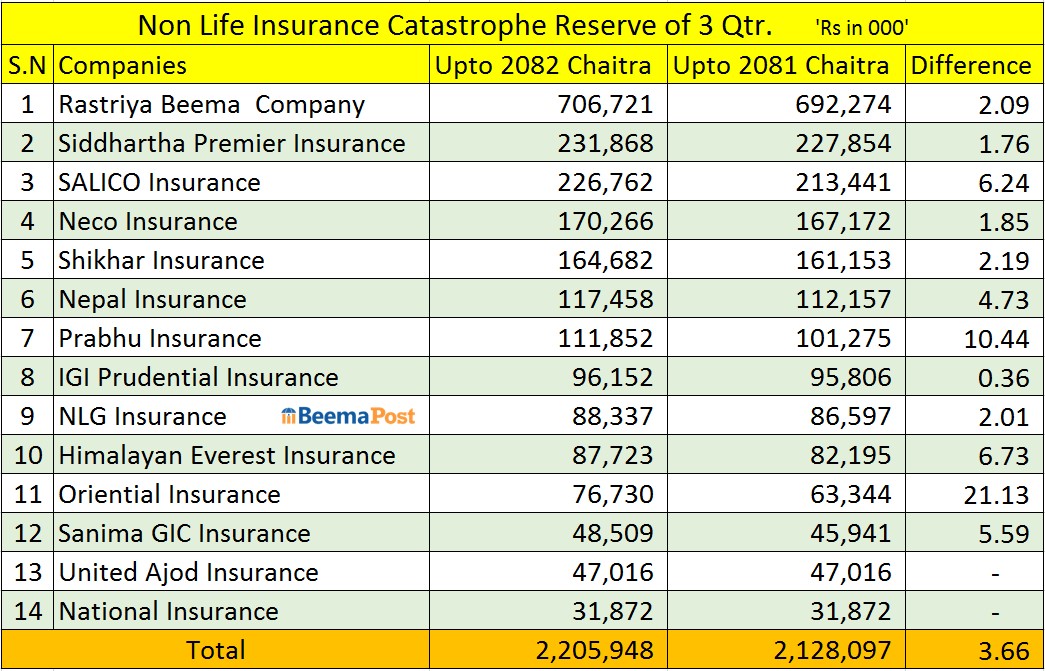
In terms of growth, Oriental Insurance recorded the strongest increase, expanding its catastrophe fund by 21.13 percent year-on-year. Prabhu Insurance followed with growth of 10.44 percent, while Himalayan Everest Insurance increased its reserve by 6.73 percent. Sagarmatha Lumbini Insurance posted growth of 6.24 percent and Sanima GIC Insurance increased its fund by 5.59 percent. Nepal Insurance recorded a 4.73 percent rise during the review period.
Moderate growth was also seen at Shikhar Insurance, whose catastrophe fund increased by 2.19 percent, while Rastriya Beema Company, NLG Insurance, Neco Insurance, Siddhartha Premier Insurance, and IGI Prudential Insurance recorded growth rates ranging from 0.36 percent to 2.09 percent. Meanwhile, the catastrophe funds of United Ajod Insurance and National Insurance remained unchanged from the previous year.
The steady growth in catastrophe reserves highlights the insurance industry’s focus on strengthening financial resilience amid Nepal’s exposure to significant disaster risks. As climate-related events and other large-scale losses continue to pose challenges, maintaining adequate catastrophe funds remains an essential safeguard for both insurers and policyholders, ensuring that companies can meet their obligations even during periods of extraordinary claims.