
Government Moves to Extend Anti-Corruption Authority into the Private Sector; Proposal Targets Irregularities in Banking and Insurance
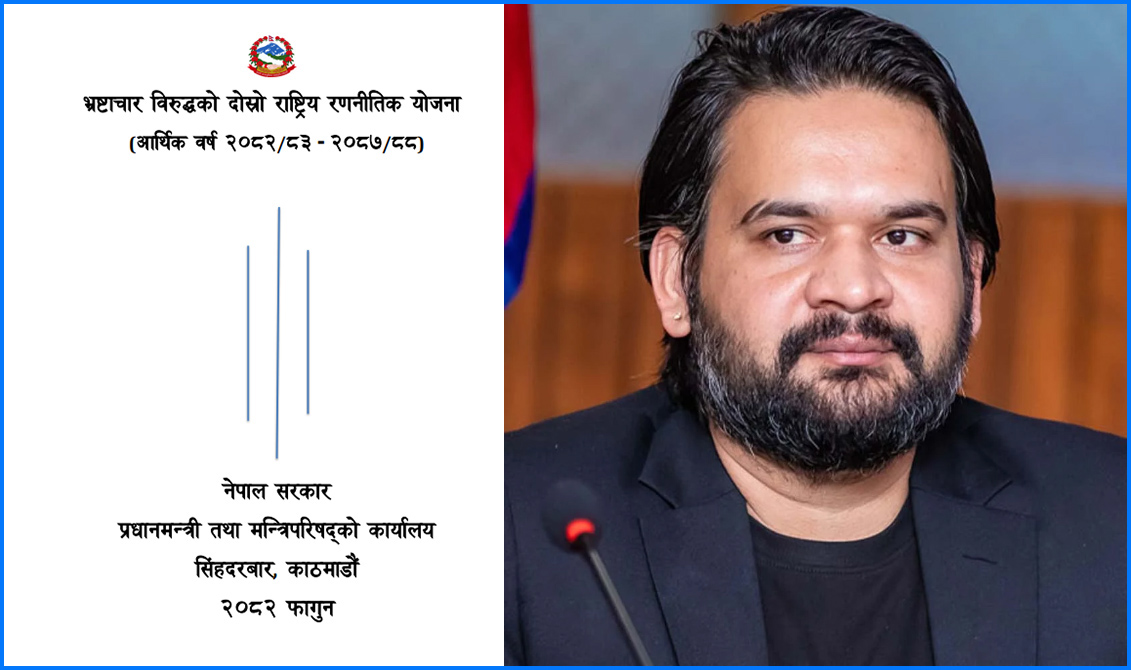
Kathmandu – The government led by Balen has decided to expand the jurisdiction of the anti-corruption authority to allow strict investigation of corruption in the private sector. The proposal is included in the draft Anti-Corruption Strategy for 2025 to 2028, which was made public by the Office of the Prime Minister and Council of Ministers on April 13, 2026.
According to the draft released last Tuesday, any financial loss or damage caused to the Government of Nepal by private sector entities will be treated as a corruption-related offense. Such cases will be investigated by the anti-corruption authority or other relevant agencies. Under Strategic Pillar 3, the draft states that legal and institutional arrangements will be introduced to investigate corruption and misconduct within government bodies, private companies, and public enterprises.
In recent years, corruption in the private sector has reportedly resulted in losses of billions of rupees annually. Business owners have been avoiding taxes by recording illegal or unjustified expenses that fall outside legitimate business activities. These practices will now be classified as corruption or abuse of authority and investigated accordingly.
The strategy has been made public in draft form, and it is not yet clear which specific laws will be amended or introduced to implement these measures. However, the document emphasizes the role of civil society and private sector organizations, including the Federation of Nepalese Chambers of Commerce and Industry, in supporting anti-corruption efforts.
The Prime Minister’s Office has also indicated that stronger implementation of existing laws will be prioritized. These include legislation related to revenue investigation, banking and financial institutions, public procurement, and good governance. Structures will be developed to ensure coordination among all three levels of government in tackling corruption.
Earlier, efforts were made in a parliamentary committee to block the extension of anti-corruption authority into the private sector. These efforts were reportedly led by Nepali Congress leader Ramhari Khatiwada. However, Prime Minister Balen Shah has now adopted a zero-tolerance approach to corruption and has prepared a long-term strategy extending until 2031 to broaden oversight and strengthen enforcement.
As a result, investments made by private entities to avoid scrutiny from anti-corruption bodies are likely to lose their effectiveness. The banking sector is believed to have been particularly active in such efforts.
The draft strategy has been opened for public feedback, with a 15-day deadline for submitting suggestions. If business groups are unable to influence revisions within this period, new laws may be introduced soon, allowing anti-corruption agencies to formally investigate the private sector.
Once these measures come into force, even prominent business figures such as Pawan Golyan and Shekhar Golchha could face legal action, especially in cases involving extravagant spending such as hosting weddings in some of the most expensive hotels in Dubai.