
Bad Loans Surge in Microfinance Sector, 18 Institutions Cross 10% NPL Threshold
Kathmandu — Non-performing loans (NPLs) in Nepal’s microfinance sector have continued to rise sharply by the third quarter of fiscal year 2025/26, according to the latest quarterly financial reports published by microfinance institutions.
Among the 50 listed microfinance companies, 34 have so far released their third-quarter financial statements. The data show that the sector’s average NPL ratio climbed to 11.35%, up from 6.87% during the same period last fiscal year, an increase of 4.48 percentage points.
Chhimek Microfinance reported the lowest NPL ratio in the sector at 2.32%, improving from 2.60% a year earlier. Support Microfinance posted an NPL ratio of 3.31%, while Guras Microfinance and RSDC Microfinance stood at 3.41% and 3.46%, respectively, reflecting relatively moderate deterioration in asset quality.
Among other institutions, Sana Kisan Bikas Microfinance recorded an NPL ratio of 4.12%, while First Microfinance improved to 4.36%. Jeevan Bikash Microfinance stood at 4.80%, showing slight improvement compared to last year. Grameen Bikash Microfinance rose to 4.94%, whereas Abhiyan Microfinance declined to 5.14%.
Manushi Microfinance reported an NPL ratio of 5.78%, while Samudayik Microfinance reached 6.78%. Swarojgar Microfinance climbed to 7.01%, whereas Deprosc Microfinance improved slightly to 7.52%. Mahuli Microfinance posted 8.17%, while Global IME Microfinance and Asha Microfinance recorded 8.69% and 9.88%, respectively.
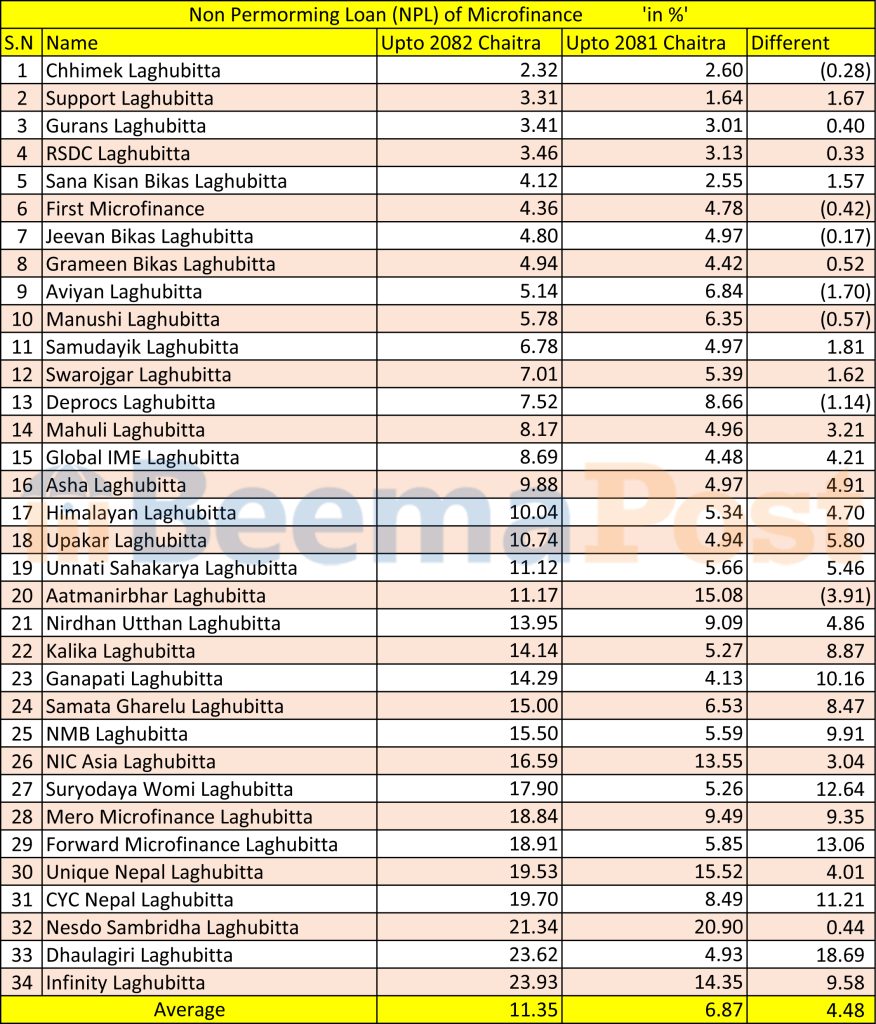
Several institutions have now crossed the 10% mark. Himalayan Microfinance reported an NPL ratio of 10.04%, while Upakar Microfinance stood at 10.74%. Unnati Sahakarya Microfinance recorded 11.12%.
Atmanirbhar Microfinance, however, managed to reduce its NPL ratio to 11.17%, down from 15.08% last year. Nirdhan Utthan Microfinance reached 13.95%, while Kalika Microfinance stood at 14.14%. Ganapati Microfinance posted 14.29%, and Samata Gharelu Microfinance reached 15%. NMB Microfinance recorded 15.50%, while NIC Asia Microfinance climbed to 16.59%.
The sector’s worst-performing institutions included Suryodaya Womi Microfinance at 17.90%, Mero Microfinance at 18.84%, and Forward Microfinance at 18.91%. Unique Nepal Microfinance reported 19.53%, while CYC Nepal Microfinance stood at 19.70%. Nesdo Samriddha Microfinance reached 21.34%, with Dhaulagiri Microfinance at 23.62%. Infinity Microfinance recorded the highest NPL ratio in the sector at 23.93%.
Overall, the data indicate a broad deterioration in the financial health of Nepal’s microfinance sector. Analysts attribute the rising level of bad loans to the slowdown in the rural economy, mounting pressure on borrowers’ repayment capacity, and increasing difficulties in loan recovery.