
Life Insurers’ Single-Premium Income Surges 56%

Kathmandu — Life insurance companies have once again become increasingly aggressive in selling single-premium life insurance policies, a product widely regarded as unfavorable for the long-term sustainability of life insurance business.
According to data released by the Nepal Insurance Authority, sales of single-premium life insurance policies increased by more than half compared to the previous fiscal year.
Life insurers’ single-premium income rose by 56 percent year-on-year. Companies generated NPR 12.24 billion in single-premium income during the review period, up from NPR 7.82 billion in the corresponding period of the previous fiscal year.
During the review period, Himalayan Life and Sun Nepal Life were the only insurers to record a decline in single-premium income compared to the previous year.
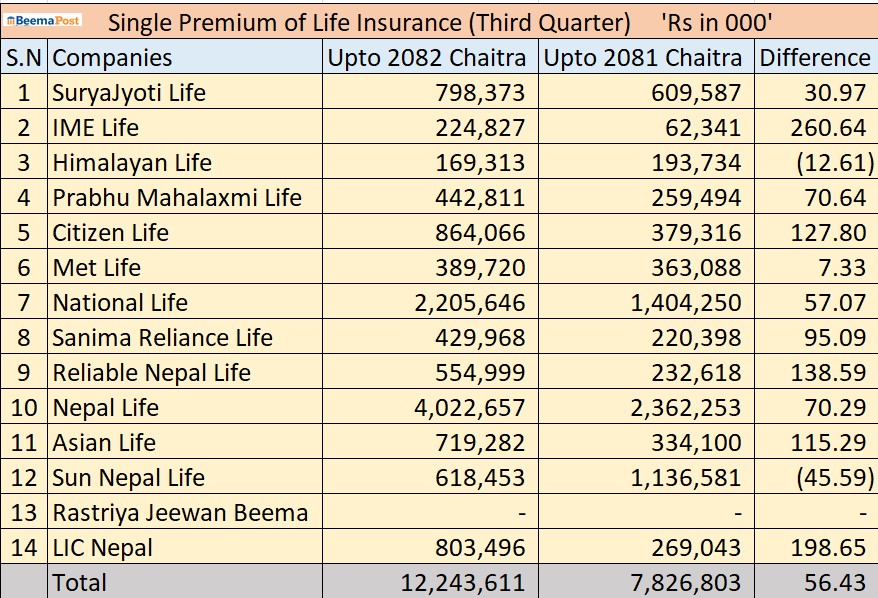
Himalayan Life’s single-premium income fell by 12 percent, while Sun Nepal Life reported a 45 percent decline. IME Life, LIC Nepal and Reliable Nepal Life recorded the strongest growth in single-premium business.
According to insurance agent Reshma Oli, insurance companies have increasingly prioritized business growth over policyholders’ interests by focusing on the sale and distribution of single-premium policies. “Companies do not have to pay high commissions to agents on single-premium policies. Since the premium is collected in a single payment, administrative costs are also relatively low,” she said. “Rather than prioritizing policyholders’ interests, companies are increasingly focusing on generating immediate profits.”
A single-premium life insurance policy is a product under which the policyholder pays the entire premium amount in one lump sum. The premium is determined based on the insured’s age and the policy term. Once the policy matures, the policyholder receives the sum assured along with any accrued bonuses in a lump-sum payment.